Monday, 14 July 2025

Overlooked: James C. Floyd, 1914-2017

James C. Floyd (l) in 1996 with Owen Maynard, a fellow engineer who worked at Avro Canada and later at NASA. Chris Gainor photo

One of the most durable controversies in Canadian history surrounds the CF-105 Avro Arrow jet interceptor, which was cancelled by the government of John Diefenbaker in 1959. More than 65 years later, every time Canada needs new military jet aircraft or there are concerns about Canadian high technology, the Avro Arrow is raised in the discussion.

Despite the prominence of the Avro Arrow and many of the people involved in creating it, the person most responsible for designing and engineering the Arrow and other aircraft from Avro Canada died more than eight years ago without any notice or attention. James C. Floyd, a British engineer who spent much of his life in Canada, passed away in Ontario, likely in the Toronto area, on April 5, 2017, at age 102. We now know about his passing thanks to a researcher who found the date from official Ontario government records and posted the information a month ago in Floyd’s entry in Wikipedia.

I have written obituary articles for a number of people associated with the Arrow, and James Floyd certainly deserves recognition of his passing, even at this late date. As the man behind the successes and setbacks of Avro Canada, he is one of the most important figures in the history of Canada's aerospace industry, and his influence reaches beyond our borders.

I had many encounters with Jim starting in the 1990s when I began writing my first of two books about Avro Canada and the Arrow, focusing on the group of 32 engineers who worked at Avro for Floyd and then were hired by NASA after the Arrow was cancelled. The Avro engineers played important roles in putting the first humans on the Moon.

James Charles Floyd was born in Manchester, England, on October 20, 1914, and at a young age he began work at the A.V. Roe Company in the U.K. He earned a diploma in engineering during World War II and took part in designing wartime British aircraft at A.V. Roe. He moved to Canada and joined Avro Canada in 1946, and became Chief Engineer a few years later. At that time, Avro Canada was building the C102 Avro Jetliner and the CF-100 jet interceptor.

The CF-100 ultimately became Canada’s only jet interceptor to go into mass production, with 692 made in the 1950s. Some were sold to Belgium, and the CF-100 served in the Canadian Forces until 1981. But as jet aircraft were relatively new when it was designed, the CF-100 had to overcome a difficult development process before it went into production.

The Jetliner was the world’s second jet transport aircraft, behind only the deHavilland Comet, and well ahead of any similar American aircraft. Unfortunately, only one Jetliner was built, and despite interest from airlines in the United States, the Canadian government ordered an end to the Jetliner in an effort to focus Avro Canada’s efforts on the troubled CF-100, which was seen as a higher priority in those Cold War days.

Many people believe that the loss of the Jetliner was a bigger loss to Canada’s aviation industry than the Arrow. I suspect that Jim Floyd was one of them, since he wrote a well-illustrated book in 1986, The Avro Canada C102 Jetliner, that remains the best reference on that aircraft.

In the mid 1950s, Avro Canada and the Royal Canadian Air Force began work on the CF-105 Arrow, which was designed to fly more than twice the speed of sound, and incorporated many state-of-the-art features in its design. Its cancellation in 1959 came after only six Arrows had been built and flown, none of them equipped with the Iroquois engine designed for it. Floyd supervised the work on the Arrow as Avro Canada’s Vice President of Engineering.

Soon after the Arrow’s cancellation and the disappearance of Avro Canada and the thousands of skilled jobs that went with it, Floyd returned to the U.K., where he worked on advanced aircraft programs, including a study that helped lead to the Concorde supersonic jet transport.

As Floyd passed retirement age, he and his wife Irene returned to Canada in 1981 and settled in Toronto. At about the same time, the controversies surrounding the Arrow and the Jetliner were gaining new prominence in Canada. The first of a long series of books decrying the fate of the Arrow appeared in 1978, and in 1980, the CBC broadcast an hour-long documentary about the Arrow.

In January 1997, the CBC aired a two-part miniseries, The Arrow, starring Dan Ayckroyd as Avro Canada President Crawford Gordon, Christopher Plummer as cabinet minister George Hees, and other prominent Canadian actors playing other characters from the story of the Arrow. Nigel Bennett depicted James Floyd.

During those years, Floyd was busy responding to the many legends, both good and bad, that had arisen around the Arrow. He actively disliked the mini-series because some characters were changed for dramatic effect, notably those of test pilots Jan Zurakowski and Jack Woodman. In addition, the mini-series ended with the popular but untrue legend that one Arrow ‘got away’ from the government-ordered destruction of the six Arrows after the program cancellation.

In 1988, a group of former Avro employees founded the Aerospace Heritage Foundation of Canada after gathering for a 30th anniversary dinner for the Arrow, and Floyd assumed a prominent role in the foundation, speaking at many gatherings it held. The foundation also sponsored the fabrication of a full-scale replica of Arrow 203, which was first exhibited at the Toronto Aerospace Museum in Downsview until that museum closed in 2011. Today the Arrow replica is on display at the Canadian Air and Space Conservancy at the Edenvale Aerodrome near Wasaga Beach, Ontario.

The foundation appears to have halted operations at about the same time as Floyd passed away, which was also when many other former Avro employees also reached the end of their lives.

I last saw Floyd in 2007, when he was 93, at an event at the Toronto Aerospace Museum.

Although Floyd passed away without notice, his life is still noted in the form of the James C. Floyd Award given every year by the Aerospace Industries Association of Canada. Floyd is also enshrined in Canada’s Aviation Hall of Fame in Calgary.

Floyd is also remembered in the many books written about Avro Canada and the Arrow, including two books that I have written: Arrows to the Moon: Avro’s Engineers and the Space Race (2001), and Who Killed the Avro Arrow? (2007).

Monday, 7 July 2025

NASA Faces A Bleak Future

When Donald Trump returned to the White House this past January, there was some hope that he might enhance America’s leading role in space exploration or at least do little harm to it. The hopes of that time have been dashed, and NASA now faces a bleak future.

Those hopes were fuelled by memories of the first Trump administration’s space policies, which brought focus to America’s space efforts, including continuing the shift to private sector providers for space transportation services, starting the Artemis program to direct human space exploration toward the Moon, and creating the U.S. Space Force in a time of growing military challenges in space from China and Russia. The policies of that administration were continued almost seamlessly by the administration of Joseph Biden.

Trump took office in January for the second time with boasts of American innovation and exploration, and a promise to have U.S. astronauts "plant the stars and stripes on the planet Mars.” Smiling nearby was Trump’s friend and supporter, SpaceX CEO Elon Musk, the personification of the new dynamism in America’s private space sector. In contrast to the many controversial and partisan picks Trump made for other leading positions in his administration, Trump had already selected entrepreneur Jared Isaacman to lead NASA, a business associate of Musk but a popular choice whose appeal crossed political lines.

The new Trump administration quickly imposed unprecedented and arbitrary cutbacks on many parts of the U.S. government, notably those related to science, and fears grew that this treatment would be extended to NASA. In April, Isaacman faced generally friendly questioning from a Senate subcommittee that sent his nomination as NASA administrator to the full Senate on April 30. By then authoritative reports indicated that NASA funding would also be chopped.

Two days later, the Office of Management and Budget (OMB) released its top line budget proposals for 2026, which called for a 25 percent cut to NASA, including a 50 percent reduction to technology development and 47 percent to science programs. The Artemis program would end after the round-the-Moon mission of Artemis 2 (whose crew includes Canadian astronaut Jeremy Hansen) and the lunar landing Artemis 3 mission. The Lunar Gateway space station, which includes Canadian participation, would be cancelled. International Space Station operations would be reduced. The Mars Sample Return program and other scientific programs in development, including Earth climate monitoring and robotic planetary exploration, were also put on the chopping block.

On May 30, the administration released its full budget proposal, which confirmed the news contained in the top line budget. Six billion dollars would come off the $24.9 NASA budget from 2025, and more details were released on the curtailment of many smaller scientific programs.

During the month of May, Elon Musk began to withdraw from his controversial government budget cutting activities for the Trump administration, and on May 30, Musk bade farewell to Trump in a media event in the Oval Office. The next day, word leaked out that Trump had withdrawn Isaacman’s nomination for NASA Administrator, and a few days later, Musk and Trump began to feud in social media posts. While the Musk-Trump feud is based on differences over Trump’s federal budget plans, the withdrawal of Isaacman’s nomination also divided the two men. There is still no word on who might be NASA’s next administrator, leaving NASA without leadership probably into 2026.

The U.S. Congress passed Trump’s “Big Beautiful Bill” on July 3, which restored funding for a few NASA programs related to the Johnson Space Center in the Republican-friendly state of Texas, including Artemis and the Lunar Gateway station and its Canadian Space Agency participation. But it will deepen the U.S. government deficit and cut social programs, which will mean that it will be more difficult to restore cuts made to NASA’s budget this year should political winds change in the future.

The 2026 NASA appropriations process involves further consideration from Congress before the budget year begins in October. Trump’s OMB is working to see that the final budget follows the budget submitted on May 30, complete with its major cuts to NASA, by arranging orders to NASA to prepare to wind down programs facing cancellation in that budget.

According to reporting by Eric Berger, the Senior Space Editor for Ars Technica, the OMB’s budget plans for NASA are driven by OMB director Russell Vought, a self-described Christian nationalist and one of the driving forces of the controversial Project 2025 to restructure the U.S. government. Vought is known to be behind plans to cut science programs across the U.S. government.

Today NASA is facing the loss of a quarter of its budget, which would leave it with the smallest budget it has had since its early days when Dwight D. Eisenhower was president. At present, NASA is being led by an interim administrator who is under orders to toe the line from the White House. This means that Vought and the OMB are calling the shots at NASA unless Congress intervenes before October.

The Planetary Society has stated that the 2026 budget proposal for NASA ends: "41 in-development and active NASA science projects, roughly a third of NASA's entire science portfolio. All Venus missions, including DAVINCI, VERITAS, and the U.S. contribution to ESA's EnVision mission, are cancelled. The Roman Space Telescope — nearly completed — is needlessly delayed with reduced funding, which would only add to the overall cost of the project. Billions of dollars of investments in unique assets and capabilities would be wasted.

"The budget proposes reducing NASA's workforce by nearly 1/3, with nearly 2/3 cuts at NASA's Goddard Space Flight Center. The lack of projects threatens the financial stability of the Jet Propulsion Laboratory. There would simply be no missions for them to work on. The Planetary Society and other organizations have characterized the proposal as an 'extinction-level event' that would usher in a functional dark age for NASA science.”

Despite efforts by some in Congress to preserve high profile but expensive human space programs such as Artemis, many observers believe that these budget plans could imperil NASA’s leadership in that area and many others. On top of the NASA budget cuts, the SpaceX Starship that is at present a key component of Artemis 3 and America’s plans to return to the Moon, is facing delays because of a series of launch and test failures.

Donald Trump is being described as a transformational president, and he may be the most transformational president for America’s space program since John F. Kennedy, whose lunar landing goal made NASA the world’s premier space agency. The cutbacks now planned threaten NASA's leading position in space exploration, at a time when China's space program is closing the gap.

The Canadian Space Agency has recently reaffirmed its association with the European Space Agency, whose scientific programs are not directly threatened by the anti-intellectual predilections of the second Trump administration. This is a wise move, as the Trump cutbacks to NASA will change the direction of space exploration going forward, making Europe a more important player as NASA surrenders its position of leadership.

Wednesday, 4 June 2025

Northern Star: A Series That Tells The Story Of Canada In Space

Over the past two years I’ve been working on a script for a documentary series that will soon be appearing on television in British Columbia and hopefully beyond.

The two-part documentary, Northern Star, tells the story of John S. Plaskett, the Ontario farm boy who grew up to become the founding father of astrophysics in Canada. Plaskett spearheaded the construction of the Dominion Astrophysical Observatory (DAO) just north of Victoria B.C. that is equipped with a giant telescope that was for a few months in 1918 the largest operating telescope on Earth.

Today the DAO remains a vital centre for astronomy in Canada, with its staff exploring the universe using bigger and newer telescopes located in other parts of the world and in outer space, including the Hubble Space Telescope and the James Webb Space Telescope. Canadians are taking a leading role in space exploration.

The documentary is based on Peter Broughton’s award-winning 2018 biography of Plaskett, also called Northern Star, and narrated by one of Canada’s greatest science communicators, Bob McDonald, the host of CBC Radio’s Quirks and Quarks.

While preparing the script, I worked with Peter Broughton, Bob McDonald, and Nick Versteeg of DV Productions, a top Canadian documentary producer whose perseverance was the vital ingredient in bringing Plaskett’s life to the screen.

The two episodes feature interviews with astronomers and visits to locations around North America. Plaskett himself is brought to life by Victoria-based actor Roger Carr.

The first episode traces Plaskett’s humble beginnings and the massive effort to build the DAO on Little Saanich Mountain. The second episode explores Plaskett’s ground breaking discovery—the rotation of the Milky Way—and how his work continues to influence space science.

The series also includes interviews with Canadian astronauts David Saint-Jacques, who spent months in space on the International Space Station, and Jeremy Hansen, who is scheduled to travel around the Moon on NASA’s Artemis mission.

Northern Star premieres on CHEK TV, Victoria’s own television station, at 8:00 p.m. Pacific Time on Friday, June 13, with part two following on Friday, June 20. It will also be available for streaming and on-demand on CHEK+. Hopefully the series will soon appear elsewhere in Canada.

Sunday, 1 June 2025

George Harris Jr., 1929-2025

George Harris Jr. (r) at the Honeysuckle Creek tracking station in Australia in 1967 with station director Tom Reid. Hamish Lindsay photo via Colin Mackellar, honeysucklecreek.net

George Harris, Jr, a British engineer who helped establish NASA’s communications network for Mercury, Gemini and Apollo, and later did the same for European Space Operations Centre (ESOC), died on April 14, 2025, in Las Cruces, New Mexico, at age 95.

Harris was one of 32 British and Canadian engineers hired by the newly formed NASA in 1959 and 1960 after the Canadian government cancelled the CF-105 Avro Arrow jet interceptor program.

Born on July 5, 1929, in Willenhall, England, Harris attended Wolverhampton Technical College and then apprenticed at the Midlands Electricity Board. After emigrating to Canada in 1954, he joined Avro Canada and worked in flight test on the CF-100 and CF-105 jet interceptor programs until the Arrow was cancelled in 1959.

After a brief stint at North American Aviation in Ohio working on the A3J Vigilante aircraft, he joined NASA's Space Task Group in 1960 and helped set up the worldwide tracking network for Mercury, Gemini and Apollo alongside John D. Hodge and others who had previously worked at Avro Canada.

Hodge, Harris and their colleagues applied their experience with control and systems concepts to the Mercury and Gemini programs, especially NASA’s round-the-world tracking stations in the Manned Space Flight Network. Harris oversaw the testing of the tracking stations with specially instrumented aircraft that simulated Mercury, Gemini and Apollo spacecraft passing overhead.

In 1962 when the Space Task Group relocated from Virginia to Houston, Texas, the site of the future Johnson Space Center, Harris moved to the Goddard Space Flight Center, where he worked to prepare the Deep Space Network, the USNS Vanguard communications ship and Advanced Range Instrumentation Aircraft (ARIA) for Apollo tracking duties. His efforts are also credited with helping make the Honeysuckle Creek station in Australia ready for Apollo.

From 1968 to 1974, Harris worked for the European Space Research Organization, a predecessor of the European Space Agency, as the head of the Engineering and Operations Directorate at ESOC in Darmstadt, Germany. There he helped set up spacecraft operations and served as flight director for satellites such as HEOS-1, HEOS-2 and TD-1A.

In 1975, Harris returned to the United States, working for four years on systems development at the Earth Operations System Data Center in Sioux Falls, South Dakota.

By the time the Space Shuttle began flying in 1981, Harris was working in the private sector but found himself involved again in human spaceflight when he was responsible for controlling the first Tracking and Data Relay Satellite (TDRS), when it was deployed from the shuttle Challenger during the STS-6 mission in 1983. When the Inertial Upper Stage failed to boost TDRS-1 into geosynchronous orbit, Harris led the successful effort to separate TDRS-1 from the balky stage and raise the satellite into geosynchronous orbit. He won the NASA Public Service Medal for his work on TDRS.

Starting in 1985, Harris worked as an aerospace consultant and held several short-term jobs, some of them involving the Ariane launch vehicle, one setting up systems for the United States Information Agency, and another where he served as Executive Director of the New Mexio State Office for Space Commercialization.

In 1997 and 1998, he worked for the Canadian Space Agency as manager of the control facility for Radarsat-1, which had been launched in 1995. His job was to supervise a set of maneuvers to make it possible for Radarsat to map Antarctica, which had not been part of its original mission, and then return it to its normal attitude.

When the Radarsat job was done, he returned home to Las Cruces, New Mexico. There he retired with his second wife Martha, who he had married in 1968 and who died in 2020. With his first wife Mary, Harris had two sons, Kelly and Robert, and a daughter, Sandra.

Tuesday, 27 May 2025

Book Review: A City on Mars: Can We Settle Space, Should We Settle Space, and Have We Really Thought This Through?

By Kelly Weinersmith and Zach Weinersmith

Penguin Press, 2023

ISBN: 9781984881724

Pages: 441

Price: $32.00, Hardcover

There are many arguments in favour of human space exploration and settlement that are advanced by people such as Robert Zubrin, Elon Musk, and the members of groups such as the National Space Society: we need to establish our species on the Moon, Mars and elsewhere in space if we are to guarantee humanity’s survival. Many discussions on the need for space exploration imply that humans can escape a whole host of Earthly problems by starting afresh elsewhere in the solar system.

In reaction to this advocacy, some scholars are bluntly questioning the ethics of attempting to make humans a multi-planet species.

One of the best-selling and most prominent books on the topic of space exploration in the past year has taken a different approach by questioning the feasibility of settling other worlds or establishing space colonies in orbit, and whether there is any chance of delivering on the promises of space advocates, at least in the near future.

The book, A City on Mars: Can We Settle Space, Should We Settle Space, and Have We Really Thought This Through? is written by the husband-and-wife team of biologist Kelly Weinersmith and cartoonist Zach Weinersmith.

The authors, who previously wrote the best-selling 2019 book Soonish: Ten Emerging Technologies That'll Improve and/or Ruin Everything, say that they started work on what became A City on Mars believing that “space settlement was coming soon,” but reached the conclusion that “the timeline is substantially much longer and the project much more difficult” than they expected. The Weinersmiths argue that space settlement is “a project of centuries, not decades” that must await progress in science, technology, and also international law.

This book starts off by assessing many of the arguments advanced by space advocates, such as that going to space will help us by providing new homes in the sky, and protect the environment by moving industry off world, that space resources will enrich us and reduce conflict, and that exploration is a natural urge that will unify humans. The authors find that real data to back up these beliefs are lacking.

Then the authors turn to the physical challenges of relocating to space, including the physiological problems facing humans who will live in space, the challenges involved in going to other bodies in space and living there, or in setting up space settlements in orbit. These challenges are much bigger than they appear at first glance, and it will take a long time to overcome them.

Perhaps most controversially, the Weinersmiths discuss the legalities involved in the exploration and exploitation of space. Many space advocates are libertarians, and this book speaks about the need for legal regimes to cover questions of ownership and how to deal with the many social problems and conflicts that will be an inevitable part of humanity’s luggage on the route to the stars. The authors argue that simply starting anew beyond the atmosphere will not erase the need for environmental regulations, labour law, or criminal justice, amongst other things.

A City on Mars discusses the history of space exploration up to the present, including the efforts by space advocates to bypass regulatory regimes for space such as the Moon Treaty of 1979. A saving grace of this book is that these discussions are served up with a generous helping of humor, breezy writing, and yes, cartoons.

Even those libertarian space advocates whose arguments are taken up in this book are well advised to read it, if only to put their beliefs to the test. We have already seen that people like Elon Musk who have advanced the technologies of space travel in impressive fashion have fallen short when it comes to keeping up with their ambitious schedules.

Space is hard, as John F. Kennedy has warned us. A City on Mars warns that space is much harder than most of us realize. It does not say that those difficulties are reasons not to go, but simply that we must be realistic about what we can achieve in space and how soon we can make our move there. The popularity and profile of this books means that space advocates cannot ignore these arguments, because they are now part of the public discourse.

Friday, 19 April 2024

The Total Solar Eclipse of April 8, 2024

The author and the eclipse on April 8, 2024

The millions of people who saw a total solar eclipse for the first time on April 8, 2024, now know about the power and magnificence of this celestial spectacle.

The April eclipse was the second of two total solar eclipses that were visible in North America in recent years, the first being the eclipse of August 21, 2017, that crossed the United States. Those two eclipses ended a long draught of total solar eclipses in North America that began in February, 1979. Both once seemed part of a distant future. Now eclipse chasers will have to travel to other parts of the world if they don’t want to wait for the next eclipse in North America, which won’t happen until 2044.

I saw the 1979 eclipse in Manitoba and the 2017 eclipse in Oregon, and I have written about them elsewhere in this blog. After 2017, I faced a difficult decision: where should I go to see the 2024 eclipse? The decision wasn’t simple because of the path of this eclipse and the fact that April weather is more problematical than the August weather we dealt with in 2017.

The narrow path of this year’s total eclipse first touched land in Mexico near Mazatlan and headed northeast through the U.S. starting in Texas and across several states, including Arkansas, Illinois, Indiana, Ohio, New York, Vermont and Maine. The eclipse’s path also included parts of Canada, including parts of southern Ontario, Quebec, New Brunswick, Prince Edward Island and Newfoundland. Totality passed south of Toronto but was visible in parts of Montreal and in other centres such as Hamilton, Kingston, Sherbrooke, Fredericton and Gander. Most of the rest of the continent got a partial solar eclipse.

The weather on April 8 was more likely to be favourable in Mexico and Texas than elsewhere. Hotel bookings and transportation in those areas would be expensive and complicated. The odds of good weather in the Canadian portion of the eclipse on April 8 were less than 50-50. Each of the past few years on April 8, I checked the weather along the eclipse path, and most years in Canada it was cloudy.

In part because of the pandemic, I didn’t make arrangements for the eclipse years in advance as I had done for the 2017 eclipse. As 2024 dawned, I concluded it was too late to arrange a trip to Mexico or Texas for a reasonable price. I know many people in Toronto, but I felt that too many people chasing the eclipse in Hamilton and points south might complicate things. So I decided to go to Windsor, Ontario, just outside the path of totality. We have relatives there, and it would be relatively easy to cross the border there to chase the eclipse in Ohio if necessary. But it was still a big gamble, and I made sure I had other things to do to justify the trip.

I didn’t get carried away with long range forecasts for eclipse day since I had already made my plans. About a week before the eclipse, I began to see social media posts from my friend Alan Dyer, who has literally written the book on photographing solar eclipses. For this master of astrophotography, failure was not an option when it came to choosing a suitable place to see and photograph the 2024 eclipse. Setting out from his home in Alberta, Alan found that contrary to expectations, the weather in Texas was not promising. He decided to drive in the general direction of eastern Canada.

As the eclipse day got closer, weather predictions called for clouds in southern Ontario, and when I arrived in Toronto on April 4, I was greeted with cold, cloudy and rainy weather. Alan drove on to Quebec, where prospects for clear skies looked better. Two days before the eclipse as I made my way to Windsor, the skies cleared. Things were looking more promising, but clouds were still predicted for April 8.

The night before, the prediction was still more promising for Ohio than the Windsor area, and Ohio locations were closer to the centreline of the eclipse, which promised a longer period of totality. I prepared to cross the border.

April 8 dawned in Windsor with blue skies. The forecast still called for clouds in the mid afternoon, when the eclipse was due to take place. The forecasts for Ohio called for longer periods of cloudiness in the afternoon, which I feared meant thicker clouds, and so I decided to stay in Canada.

Accompanied by my wife, along with her sister and her husband, we drove south from Windsor through Amherstberg into the path of totality. Many eclipse chasers in the area were already arriving in Point Pelee Park, which was closer to the centreline but involved very limited access, so I thought we might set up in Leamington. Before we got there, we found a great spot to watch the eclipse at Colchester Harbour and Beach. The Windsor Centre of the Royal Astronomical Society of Canada (RASC) had set up tents and telescopes there, a restaurant, coffee shop and other facilities were nearby, and scores of people were already settling in to watch the eclipse over Lake Erie.

Looking south across Lake Erie, we saw a bank of clouds that everyone hoped would stay where it was. But true to the prediction, the clouds moved our way and covered the sun as the partial phase of the eclipse began a little before 1 p.m. Fortunately, the clouds weren’t very thick and we could follow the Moon as it covered the face of the Sun, a view assisted by our eclipse glasses or the filtered ‘eclipse telescope’ I brought along.

A half hour ahead of totality, the temperature in the area began to noticeably cool. I recall the temperature reduction in the 2017 eclipse cooling closer to the time of totality, but that was in the warmer weather of August.

Finally, at about 3:12 p.m., totality began. We were amongst the first to see totality that day from Canadian soil. The transition from needing eclipse glasses to full totality with the naked eye seemed to be prolonged to me, but finally we got our 90 seconds of totality and dark skies. Venus was plainly visible through the thin layer of cloud, but I don’t recall seeing Jupiter or any other celestial object. The incandescent but not overpowering glow of the Sun’s corona took centre stage. No photo has ever done justice to that sight.

In the moments leading into and out of totality, the lighting of the area took on a strange hue. During totality, my viewpoint overlooking Lake Erie allowed me to see the approaching “sunset” to the west and the receding “sunrise” to the east. During this time, I took a couple of photos of the sun and of the light effects around the horizon with my iPhone, and I set up my iPad to film totality. I wanted to spend most of totality enjoying the view rather than spending a lot of time messing with cameras.

All too soon, totality was over, and soon people started to leave. We remained for most of the rest of the eclipse to savour the incredible spectacle. By the time we drove back to Windsor, all the clouds had disappeared. So had the crowds, and as a result we encountered no traffic jams.

The hours and days that followed seemed to be a giant debrief on this event. Who got a good view of the eclipse? Who got skunked by the weather? Those were the major topics of conversation with everyone I met. The evening of April 8 I attended a meeting of the Victoria Centre of the RASC on Zoom, and a few days later I attended a meeting of the RASC Mississauga Centre in person, both full of eclipse talk.

To sum things up, those in or near Mazatlan, some on cruise ships, enjoyed clear views, and the weather in Texas was not great but allowed brief glimpses of the Moon blocking the Sun. Most people who saw the eclipse from both the north and south sides of Lake Erie got a good view of the eclipse through thin clouds. Those who viewed the eclipse from Niagara Falls and eastern Ontario had to deal with thicker clouds, which meant fleeting views of totality or no view at all. The weather was better in Montreal, and those in Sherbrooke and the surrounding area enjoyed clear skies. I heard reports of good weather in New Brunswick and not so good weather in Newfoundland. Alan Dyer got his photos. Only a few people I know missed all of totality.

So the viewing conditions for the 2024 total solar eclipse turned out to be less than perfect but better than most of us could hope for. My friends who had never seen a total solar eclipse were most impressed by the sight. Many found that the eclipse stirred their emotions.

Many astronomical events don’t impress non-astronomers, and that is even truer today when some events such as “Supermoons” are overhyped by people in the media or on the internet. But total solar eclipses never fail to impress, as they should, since they are so rare and so amazing.

Now the question arises - when is the next one? August 12, 2026, in Greenland, Iceland and Spain. In North America, the wait will go on until August 23, 2044. How long will my wait go on? That's a decision for another time.

Friday, 10 November 2023

Asteroid (20041) Gainor

A representation of the orbit of (20041) Gainor, with its position on November 9, 2023 (NASA JPL)

This week the Working Group on Small Bodies Nomenclature of the International Astronomical Union (IAU) published its latest list of about 40 new names it had approved for minor planets. Twenty of them were named after Canadians, including a number of people I know from my involvement in astronomy. One was named (20041) Gainor, after me.

(20041) Gainor had been discovered on December 18, 1992, by Japanese astronomers A. Natori and T. Urata, and it was known as 1992YH before this week. Over time after the original discovery, additional observations had shown that it is in the Main Belt of asteroids between Mars and Jupiter, about three times as far away from the Sun as the Earth. It takes 1523 days or more than four years, to make one orbit of the Sun. The asteroid is 5.167 km in diameter and rotates every 2.62 hours, and it is tilted nearly 14 degrees to the ecliptic.

The biography issued with ‘my’ asteroid, which can also be called 20041 Gainor, notes that I am "a Canadian journalist, historian and amateur astronomer with a PhD in the history of technology from the University of Alberta. He has written six books about aerospace, including Not Yet Imagined, the operational history of the Hubble Space Telescope, published by NASA in 2021. Gainor was President of the RASC in 2018–2020.”

The first asteroid, Ceres, was discovered in 1801, and today roughly half a million minor planets have been assigned a number. So far, only about 20,000 have been named. Discoverers have 10 years to suggest a name, after which the naming goes to the IAU’s Minor Planet Center. Names must be 16 characters or less, one word (although first and last names are often combined), pronounceable, non-offensive, non-commercial, and not too similar to an existing name.

Today many astronomers, usually armed with cameras, along with automated telescopes and even satellites, are involved in the search for asteroids, particularly those that might collide with the Earth. Multiple observations are required to establish the path of each asteroid. Canadians are involved in the search for asteroids, including some who use the Plaskett Telescope at the Dominion Astrophysical Observatory in Saanich, B.C., a few miles away from my home. Others are consulted on good names for asteroids, and I thank those people for their role in this honour.

This week’s list of minor planets from the IAU includes the names of several friends from the Royal Astronomical Society of Canada, including my Victoria Centre colleague Lauri Roche, and prominent science journalists like Ivan Semeniuk, Dan Falk and Nicole Mortillaro, along with environmentalist David Suzuki, the best known Canadian in this list. The others on the list come from a variety of countries and occupations, the best known being the namesake of (332884) Arianagrande.

Right now (20041) Gainor is more difficult than usual to see because it is on the other side of the Sun from the Earth. Even when the asteroid and the Earth are on the same side of the Sun some months from now, it will be very dim - around 13th magnitude. But I hope to get a chance to see it some time.

Wednesday, 2 August 2023

Canada World Youth, 50 years later

The author and friends in Fiji, 1974

Fifty years this week I boarded an Air Canada flight that took me from my home in Edmonton to Toronto, which I had never visited before. I was just a few weeks out of high school, and like many other people at that point in their lives, I was unsure about what direction my life would take in the years ahead, aside from a general intention to go to university.

I was joining a youth exchange program then in its second year of operation called Canada World Youth (CWY) or Jeunesse Canada Monde (JCM). From my arrival in Toronto through the next nine months into May 1974, I would travel with other young people, most of them like me just out of high school, around Canada and then to an exchange country, in our case, Fiji in the South Pacific.

In its first year, 1972-1973, CWY had youth exchanges with Cameroon, Mexico, Malaysia, Tunisia, and Yugoslavia involving 240 youth from Canada and another 300 from the exchange countries. As I applied and went through CWY’s selection process in June and July 1973, there was no mention that Fiji was amongst the possible exchange countries in the coming year. I had no idea about going to Fiji until I received a letter in mid-July announcing my selection for the program.

CWY was the brainchild of Jacques Hébert (1923-2007), a Montréal journalist, author and publisher who was a close friend of Pierre Elliott Trudeau, then the prime minister of Canada. Later on, Hébert founded a similar organization for youth, Katimavik, and was named to the Senate by Trudeau. Although CWY was a private organization, most of its funding in its early years came from the federal government.

In its original form, CWY was seen to be an educational experience stressing group living and immersion in cultures differing in religion, language, ethnic origin and form of government from our own. Our Fiji team in year two (1973-1974) started with three groups of 10 Canadians, plus three group leaders and two coordinators. Since many of the Canadian participants came from Québec, the cross cultural aspect of our program began immediately, and a few weeks later, when each Canadian group was enlarged by a similar number of Fijian participants and staff, there was much more cross cultural exposure for everyone.

Fiji had been a British colony for nearly 100 years until it gained its independence in 1970. During Fiji’s colonial period, the British authorities introduced indentured labour from India, and by the time of independence, the populations of indigenous Fijians and those with roots in India were nearly equal. As subsequent history that includes military coups would prove, the two groups have had an uneasy relationship.

The 1970s also was a time when support for separatism was growing in Québec, especially in our age group. Since a Québec election took place during our sojourn in that province, our time in CWY was also something of a crash course in Canadian political differences.

Much of what we learned in CWY showed that our home country was far from perfect, especially from the viewpoint of distant countries that were subject to the attentions of Canadian-based corporations.

Our four-and-a-half months in Fiji, which began just before New Year’s 1974, immersed us in the realities of people who lived in what was then called the Third World. This meant a much different standard of living and many features of the colonial experience, including residential schools for many indigenous Fijians. Up to that time I had lived my life in a province where multiculturalism lay in the future. In Fiji I had the edifying experience of living in places where I was the visible minority.

For me CWY was a most thorough educational experience that taught me much about the world, my country, and also myself. One of the paradoxical strengths of that experience was that it was so poorly organized. Many of us had grown up in situations where we had become accustomed to having our lives looked after. In CWY we had to pick up the pieces of what had been planned for us, which involved living in isolated communities and helping out with various community projects.

Some participants in our team had difficulty coping with the challenges presented by CWY, and many including me had issues readapting to home after our CWY exchange was over. Later on I learned that Canadian participants in exchanges with other countries had far worse problems than we did in Fiji.

We also learned that the Fijian participants were not happy with their time in CWY, since they wanted more practical educational experiences that would help them build up their homes and their country. As a result, Fiji remained in the program only for one more year.

Canada World Youth changed and evolved over the years. In our year we had three month-long projects in various parts of Canada and then three or four projects in Fiji. Soon CWY changed its format so that participants took part in fewer but longer community projects that benefited host communities more and provided more practical benefit to the participants. CWY became better with time.

Over time, government funding for CWY fell away, and CWY came to rely on private sources of funding, including funds raised by participants.

Canada World Youth was often compared with the U.S. Peace Corps. But the Peace Corps involved sending skilled workers to developing countries, unlike CWY, which was built around two-way exchanges not necessarily involving skilled people.

In later years, CWY got involved in projects in Canada promoting reconciliation with Canada’s indigenous peoples. But the lengthy COVID-19 pandemic forced CWY to suspend operations, and the disruption the pandemic caused made it difficult for the organization to resume activity. So last fall, just as CWY passed its 50th anniversary, it closed down.

Over the decades since my own CWY experience ended, I have run into many former CWY participants and staff who became activists and community leaders, and this legacy continues.

Today we are living in a time when we are facing global problems such as pandemics and climate change, problems that are being met too often by forms of ignorance such as nationalism, nativism, and wilful denial of reality. To combat these forms of ignorance, more than ever we need more educational opportunities like Canada World Youth for up-and-coming generations.

Tuesday, 18 July 2023

Peter Armitage, NASA Engineer worked at Avro Canada 1929-2023

Peter Armitage (left) with Astronaut Virgil I. Grissom during Mercury recovery testing exercise in 1961.

Peter Armitage, one of the last of the British and Canadian engineers who helped form the nucleus of NASA’s early human space programs, died on July 10 at age 94 in Houston, Texas. During his career at NASA, Armitage helped develop recovery systems for the Mercury, Gemini and Apollo spacecraft, and later managed the Lunar Receiving Laboratory and the Space and Life Sciences Directorate at the Johnson Space Center.

He was one of 32 engineers hired by the newly formed NASA in 1959 after the Canadian government cancelled the CF-105 Avro Arrow jet interceptor program. Most of those engineers had come to Avro Canada from the United Kingdom.

Peter John Armitage was born on March 5, 1929, in Leeds, Yorkshire, the son of a tool and die maker and a seamstress. As a youth, Armitage learned from an uncle how to machine metal parts, and his family moved to the south of England after his father lost his job. As World War II broke out, his family lived in Hamble, a small village just outside of Southampton, and the young Armitage was selected to be an “aircraft spotter” for his school. When they saw approaching German aircraft, Armitage and his fellow spotters rang bells, and the students entered the air raid shelter, and throughout his life, Armitage maintained his love for the Supermarine Spitfire and other aircraft of that era.

When the war ended, Armitage got work as a trainee draughtsman in the aircraft industry and undertook studies at Southampton University. In 1948 he got work at the Cierva Autogiro Company, working on the Skeeter light observation helicopter that was used by the British Army. In 1950, Armitage was drafted into the Royal Air Force (RAF), and after flight training, Armitage was posted to the RAF 617 squadron, which had won fame in the war as the ‘Dam Busters.’ His decision to leave the RAF after two years may have saved his life because his RAF crewmates were killed on a mission shortly after he left.

Armitage got work at Folland Aircraft, where he worked on the wing structure of a lightweight fighter called the Midge, the forerunner to the aircraft known in the RAF as the Gnat. Persuaded by a colleague to apply for a job at Avro Canada in Toronto, Armitage was chosen and he sailed for Canada in November 1952. His stay in Canada was interrupted in 1955 and 1956 when Avro gave him a scholarship to study at the College of Aeronautics at Cranfield, where he earned his master’s degree.

While serving at RAF Binbrook in Lincolnshire, Armitage met his future wife June Blackett, and they were married in Toronto in 1954. They had four sons.

At Avro Canada, Armitage worked on flight testing of the CF-100 Canuck subsonic jet interceptor, which Avro produced in large numbers for the Royal Canadian Air Force, and for the Avro Arrow, which the Canadian government controversially cancelled on February 20, 1959, during early flight testing, throwing hundreds of engineers and thousands of others out of work.

A few days after it began operations in October 1958, NASA started its first human space program, Project Mercury, at the Space Task Group (STG) at NASA’s Langley Research Center in Hampton, Virginia. Because STG badly needed skilled engineers, STG leaders including Robert Gilruth flew to Toronto to interview Avro engineers after the Arrow was cancelled. In April STG hired 25 Avro Canada engineers, and another seven joined NASA later. The immigration process for the new recruits was accelerated, and when Armitage and some of his former Avro colleagues reported for work on April 27, 1959, they went through their employment induction process at the same time as the seven new Mercury astronauts.

Armitage was soon assigned to the recovery branch, and for much of the next decade at STG and the Manned Spacecraft Center (later renamed after Lyndon B. Johnson), which succeeded STG in 1962, Armitage was involved in testing recovery systems for Mercury, Gemini and Apollo spacecraft. These systems included parachutes, the landing bag on the base of the Mercury capsule that absorbed forces at splashdown and kept the spacecraft upright in the water, Gemini’s paraglider which was cancelled before flights began, much to Armitage’s relief, and on Apollo the plans to protect Earth from possible contamination from possible biological agents from the Moon.

In 1961 Armitage joined his British colleagues from STG on an informal NASA cricket team that played a game against a cricket team from nearby William and Mary University, which the university team won. The NASA cricket team reformed in 1964 but a planned game against visiting Royal Navy sailors never took place because of an approaching hurricane. Along with many other engineers who had worked at Avro, Armitage became a citizen of the United States in 1964.

Gilruth gave Armitage an “out of the blue” assignment when a Lunar Landing Training Vehicle (LLTV) crashed in 1968, nearly killing astronaut Neil Armstrong. Armitage directed a flight certification program for the remaining LLTV before training with the vehicle was allowed to resume. With Apollo recovery systems set in 1969, Armitage attended management school at Stanford University in California on a Sloan Fellowship.

When he returned to Houston, Armitage served as manager of the Lunar Receiving Laboratory when astronauts brought lunar samples back from the Apollo 14 and 15 missions in 1971. At the time, many scientists were discontented with their place at the laboratory, and Armitage was able to make changes that eased the scientists’ concerns. Fresh from that success, Armitage moved to the Science Directorate, later the Space and Life Sciences Directorate, where he helped manage scientific work on Skylab and early shuttle flights.

Armitage retired from NASA in 1986 as the last of the former Avro Canada engineers still at NASA. Soon his friend former astronaut Donald K. “Deke” Slayton hired him for a pioneering effort in private space flight, Space Services, Inc., where Slayton and Armitage worked on developing the Conestoga rocket. Armitage retired shortly after the company was sold in 1990 when contracts for rockets proved to be scarce.

In retirement Armitage pursued his hobby of restoring classic British cars at his home near the Johnson Space Center.

Thursday, 6 April 2023

Artemis II Is Far From NASA's First Lunar Flight With Canadian Content

Tom Kelly (left) and Owen Maynard (centre) at the NASA Mission Control Center in Houston during the flight of Apollo 11 in 1969 (NASA).

Officially, Canadian astronaut Jeremy Hansen is part of the crew of the upcoming Artemis II flight around the Moon thanks to an agreement between NASA and the Canadian Space Agency which will see Canada build Canadarm 3 for the Lunar Gateway space station that is part of the Artemis program.

I also like to think of Hansen’s participation in Artemis II as being a belated recognition of Canada’s role in helping NASA get the Apollo astronauts to the Moon more than half a century ago.

While Canada did not play a formal part in Apollo, the Canadian government’s decision in 1959 to cancel the CF-105 Avro Arrow jet interceptor program led to NASA hiring 31 of Avro’s top engineers to join Project Mercury, which put the first U.S. astronauts into space in the early 1960s. The Avro engineers also played prominent roles in the Gemini spaceflights that followed Mercury, and Apollo itself. Some of the former Avro engineers went on to work in the Space Shuttle program and one worked on the International Space Station. Seventeen of the engineers had come to Avro Canada from the United Kingdom, one was from Poland, and 13 were Canadian.

Two of the most important members of the Avro group came from Canada. James A. Chamberlin had been born in Kamloops B.C. and raised in Toronto. When the Arrow was cancelled in 1959, he was the 43-year-old chief of technical design at Avro Canada, and once at NASA, he was named head of engineering for the Mercury spacecraft. Not long after President John F. Kennedy challenged NASA to send astronauts to the Moon, Chamberlin began designing a new two-man spacecraft called Gemini that would prepare astronauts and flight controllers for the challenges of Apollo’s flights to the Moon.

By the time Gemini got its official start in late 1961, NASA officials were engaged in a heated debate about how Apollo would get to the Moon. There were three concepts, starting with a direct flight in a single spacecraft to the lunar surface and back to Earth. A second proposal involved launching the spacecraft in parts using two or more Saturn V rockets, assembling the parts in Earth orbit, and then heading for the Moon. A third concept, called lunar orbit rendezvous, involved launching two spacecraft atop a single Saturn V rocket. The crew would spend most of the trip in a mother ship, and a second smaller craft would descend from the first craft in lunar orbit to the Moon’s surface, and then return the astronauts to the mother ship for the return trip home.

At first, most NASA officials charged with the lunar flight favoured a direct flight, in part because it would avoid the complexities of rendezvous and docking in lunar orbit or of assembling a spacecraft in Earth orbit. An engineer from another part of NASA named John C. Houbolt, campaigned within the agency for lunar orbit rendezvous, which he had concluded would save a massive amount of weight, fuel and cost because most of the spacecraft, such as the Earth landing system, would not have to be lowered to the lunar surface and then launched back to Earth. One of the first people to agree with Houbolt was Chamberlin, who quickly drew up a daring plan to fly a Gemini spacecraft to lunar orbit, along with what he called a “bug” that would carry a single astronaut to the surface and back to the Gemini. While NASA rejected Chamberlin’s idea of flying Gemini to the Moon, his proposal helped change minds at the space agency to favour flying Apollo to the Moon with lunar orbit rendezvous.

Another Canadian from Avro, Owen E. Maynard, a native of Sarnia, Ontario, had been involved in the Apollo program from its beginning in 1960. Maynard quickly began designing a two-man craft that became known as the lunar module or LM. Along with his drawings, Maynard travelled with other Apollo experts to NASA installations to sell lunar orbit rendezvous to the whole agency. NASA officially opted for lunar orbit rendezvous in July 1962, and in November, Grumman Aircraft won the contract to build the lunar module.

Maynard worked with Grumman’s engineering team under Tom Kelly on the LM, and in 1964 he was promoted to head the systems engineering division, where he was responsible for making sure that all of the components of the Apollo spacecraft worked in concert with the Saturn V rocket and the systems on the ground. Two years later, Maynard was moved to the top job in Apollo mission operations. There he was responsible for designing missions and for setting the sequence of Apollo test flights that led to the first lunar landing attempt on Apollo 11.

The fire that killed Apollo 1 astronauts Virgil Grissom, Edward White and Roger Chaffee during a launch pad test in 1967 led to many changes in Apollo, including a management shakeup that saw Maynard returned to his previous job as head of systems engineering. He played a key role in the missions that led to the lunar landing, notably Apollo 8, which orbited the Moon 10 times in December 1968 with three astronauts on board. During the flight of Apollo 11, Maynard was one of the managers working in the Mission Control Center in Houston. In the time leading up to Apollo 11, Chamberlin served as a trouble shooter for NASA management.

Several other engineers from Avro Canada also made their mark on Apollo. Bryan Erb, an Albertan, helped develop the Apollo command module’s heat shield and then managed the laboratory that handled the returned lunar samples. When the Apollo 11 crew returned to Earth, the first person who greeted them on board the recovery helicopter was a Canadian physician, Dr. William Carpentier, who joined NASA after an upbringing in Alberta and B.C. Two natives of Saskatchewan worked on spacecraft systems – Leonard Packham on communications, and Richard Carley on guidance and navigation. Robert Vale of Toronto helped develop the experiment packages that the Apollo astronauts deployed on the lunar surface. British engineers who worked at Avro Canada had leading roles in Apollo, including John Hodge, Rod Rose, Peter Armitage, Morris Jenkins and Dennis Fielder.

Apollo 11 and five other Apollo missions took astronauts to the surface of the Moon. Each lunar module descent stage and its landing gear included four legs and struts that extended and supported the legs. Most of the landing gear, except for the bottom parts of the legs and the landing pads, were precision made at Héroux Machine Parts Limited (now Héroux-Devtek) in Longueuil, Quebec.

I had the privilege of meeting most of the Avro engineers who worked for NASA while writing my book, Arrows to the Moon: Avro’s Engineers and the Space Race (Apogee Books: 2001).

By the time Apollo was wrapping up in 1972, NASA was negotiating with the Canadian government to make Canada a formal partner in the Space Shuttle program by contributing the Space Shuttle Remote Manipulator System or Canadarm to the shuttle. In 1983, at NASA’s invitation, Canada selected its first astronauts and Marc Garneau became the first Canadian to fly in space in 1984.

Now Jeremy Hansen stands to be the first Canadian to fly around the Moon, following in the footsteps of other Canadians who worked in the design suites, meeting rooms and control centres of Apollo, and his Canadian astronaut colleagues who flew on board the Space Shuttle and the International Space Station.

Canadian Astronaut Jeremy Hansen (NASA).

Monday, 8 August 2022

Book Review: Wonders All Around: The Incredible True Story of Astronaut Bruce McCandless II and the First Untethered Flight in Space

By Bruce McCandless III

ISBN: 978-1-62634-865-3

Pages: 247

Price: $24.95, hardcover

As we enter the seventh decade of human space flight, there is a wealth of astronaut biographies available to interested readers. Most autobiographies and biographies of astronauts from the Moon race era have been written, and today we are seeing many biographies from many who flew aboard the Space Shuttle.

The career of Bruce McCandless II – a Group 5 astronaut who had to wait nearly eighteen years for his first ride into space after watching many others from his group fly to the Moon – is not unique, since other astronauts selected in his group and the two groups that followed had to wait nearly as long or even longer to go into space.

Nor is the new biography of McCandless, Wonders All Around, written by his son Bruce McCandless III, the only book written by an astronaut offspring.

But this book, written four years after the elder McCandless’ death, is an engaging read that tells the stories of the author and the subject in an honest fashion.

Bruce McCandless II was a member of the “Original Nineteen” group of astronauts selected in 1966 to fill out crews for Apollo and Skylab. Two of those 19 never flew, and three had to wait until the shuttle began flying in the 1980s to get into space.

McCandless will always be associated with NASA’s greatest moment, since he was the spacecraft communicator in mission control who conversed with Neil Armstrong and Buzz Aldrin during their moonwalk on Apollo 11. His son argues that McCandless’ career suffered from that point onward because he apparently failed to transmit an order to Armstrong and Aldrin to cut their lunar excursion short, a claim this reviewer finds questionable.

When he did get to fly on board the shuttle, McCandless got two memorable and important flights. After having spent years working to develop astronaut maneuvering units for spacewalking astronauts, McCandless became the first person to make an untethered spacewalk when he tested a maneuvering unit on board the STS-41B mission in February 1984. The photos of his feat are amongst the most iconic images of the space shuttle era.

Six years later, McCandless was on the STS-31 mission that deployed the Hubble Space Telescope. In preparing for that mission, he and astronaut Kathy Sullivan developed tools and techniques that proved to be crucial in the work of repairing and maintaining Hubble during the five servicing missions that followed their deployment mission. Even as he retired as an astronaut following STS-31, McCandless played a key role in helping scientists decide how to restore Hubble after it was found that its main mirror had been ground to the wrong shape. The fact that Hubble still functions into its fourth decade owes much to the work of McCandless and Sullivan.

The younger McCandless gives an honest account of how his father’s personality, which could be described as so driven that it even stood out amongst his fellow astronauts, affected his career and his family life. The book also describes how the author’s mother, Bernice McCandless, coped with living with an astronaut and two spirited children who grew up in the turbulence of the 1960s and 1970s.

In discussing his own life, the author provides fascinating details about growing up in the shadow of the Johnson Space Center, which wasn’t too far away from other less glamorous industries in the Houston area that polluted the air and provided teenagers from relatively hardscrabble backgrounds to the high school young McCandless attended.

For anyone interested in the astronauts of McCandless’ time and their families, this book is worthwhile reading.

Wednesday, 13 July 2022

The First Images From the James Webb Space Telescope

This week NASA released the long-awaited first images and scientific data from the James Webb Space Telescope. JWST's dramatically detailed images of a stellar nursery, a dying star, a cluster of galaxies, and JWST’s first ‘deep field’ follow on similar images from the Hubble Space Telescope over its 32-year run as the Earth’s premier space telescope. While this new release doesn’t represent a major leap in knowledge beyond what we have from HST and other telescopes, it promises that JWST will soon provide dramatic new findings about the history of our universe.

Starting in 1995, HST began a series of lengthy exposures into seemingly empty corners of the universe that revealed large numbers of galaxies billions of light years away. These images, known as Hubble Deep Fields, have taken us to within a billion years of the Big Bang that marked the beginnings of our universe about 13.8 billion years ago. Hubble’s cameras took exposures of roughly a week in length to obtain these revolutionary images, and more recent Deep Fields have exploited gravitational lensing, where galaxies bend light from objects that are behind them and farther away.

JWST is designed to look farther out in distance and farther back in time than HST by observing in infrared wavelengths. Objects that are moving away from us at high speeds, such as distant galaxies and other objects, are found at infrared wavelengths because of their movement away from us. (HST observes mainly in optical wavelengths familiar to humans.)

The JWST Deep Field image released this week is similar to Hubble Deep Field images, but it required only a few hours of exposure because of its much larger light gathering capability compared to Hubble. That means we will soon be contemplating JWST Deep Fields that go well beyond the Hubble Deep Fields and this week’s JWST Deep Field. We will see how our universe evolved very early in our history, learning about the processes that amongst other things led to our own creation.

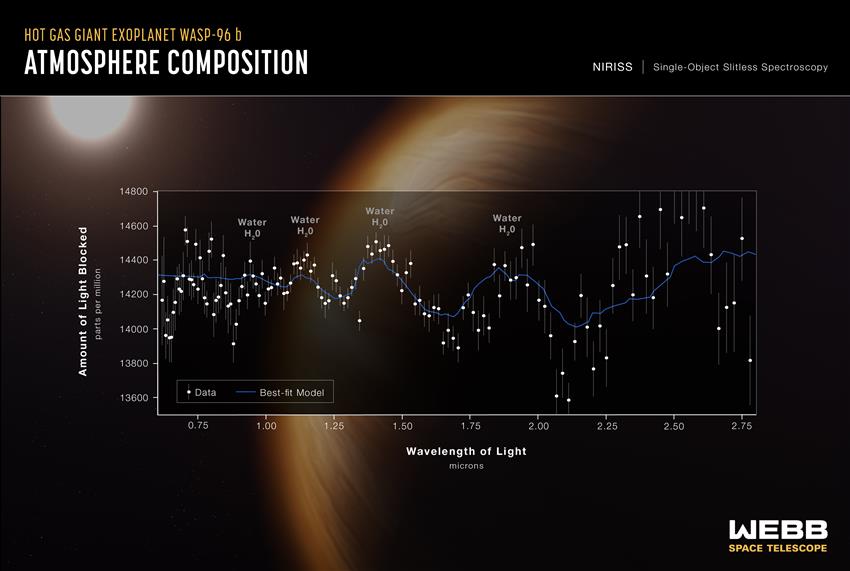
Along with four dramatic images, the scientists running JWST released a chart that shows evidence of water in the atmosphere of a planet known as WASP-96 orbiting a star 1,150 light years away. While WASP-96 is too hot and located too close to its star to host any form of life, the precision and wealth of information JWST gathered about its atmosphere shows that JWST will be able to advance the search for habitable planets by observing smaller planets in locations more friendly for life.

The instrument used to find this data is JWST's Near-Infrared Imager and Slitless Spectrograph (NIRISS) which was built by Canadian scientists and engineers with the support of the Canadian Space Agency. This week’s first release of data from NIRISS marks a major step forward for Canadian astronomy.

While Canadian astronomers have made observations with HST and other space telescopes, Canada was not a formal partner in HST, which was built by NASA and the European Space Agency. With its contribution of NIRISS and JWST’s Fine Guidance Sensors, which aim the telescope and also provide scientific data of their own, Canada has taken a central role in the most ambitious space astronomy program of this century.

Most astronomers do not rely on images to explore the cosmos. Spectrographs such as NIRISS take the 'fingerprints' of stars, planets, nebulae and other objects, providing information about their chemical makeup, temperature, mass and distance, amongst other things. JWST’s gigantic segmented mirror will allow JWST to provide more precise information about more objects in space than any other instrument. While there are larger telescopes on Earth, our atmosphere blocks many wavelengths of light, which is why astronomers get more information from space telescopes.

While writing my book about Hubble, Not Yet Imagined, I often traveled to the HST control centre at NASA’s Goddard Space Flight Center near Washington D.C. There I was also able to follow the construction of JWST before it was moved to the launch pad.

Although Hubble is nearing the end of its lifetime, it is far from being replaced by JWST. In fact in the coming months, JWST and HST will work in tandem with each other to produce coordinated sets of observations that will cover wide ranges of wavelengths.

Planning for JWST began more than 30 years ago, even before Hubble was launched. It took 20 years to build, and cost more than US $10 billion. Along the way, JWST encountered many problems that nearly led to its cancellation. But it was finally launched into space last Christmas Day, and in the weeks that followed, it successfully unfolded and aligned its 18 mirror segments and its tennis-court-sized sunshield that helps chill JWST’s instruments to operate at the low temperatures required to find infrared light. This week JWST's scientific payoff began.

HST and other telescopes of its time turned humanity’s understanding of our universe on its head, and raised as many questions as they answered. This week we learned that JWST has the technological chops to further revolutionize astronomy. Stay tuned for some major scientific surprises.

Friday, 24 June 2022

Book Review: Escaping Gravity: My Quest to Transform NASA and Launch a New Space Age

By Lori Garver
Diversion Books, 2022
ISBN: 9781635767735

This review appears in issue 29:2 of Quest: The History of Spaceflight Quarterly.

Spaceflight and particularly human spaceflight have gone through some major changes in this third decade of the 21st century. In 2020, the first crews flew aboard the SpaceX Dragon spacecraft and the Falcon 9 rocket to the International Space Station, and since then Dragon’s flight manifest has included the first purely private flights of humans into space.

The rise of SpaceX to its commanding position in the space business of course owes a great deal to the drive and vision of Elon Musk and the team he assembled, but it also got a crucial assist from NASA when it overcame its traditional way of doing business by putting the private sector at its heart.

Arguably the person at the center of this major change at NASA is a woman who wasn’t even born when the first American rocketed into space in 1961, Lori Garver. After serving for nine years as the executive director of the National Space Society, Garver went to NASA in 1998, serving for three years as Associate Administrator under Administrator Daniel Goldin and President Bill Clinton.

Out of office in 2001 and 2002, Garver gained public attention from her attempt to become the world’s first “Soccer Mom” to fly to the ISS, an effort that ultimately fell short. During that decade, she advised the John Kerry, Hilary Clinton and Barack Obama presidential campaigns on space issues. Under President Obama, she served as Deputy Administrator of NASA from 2009 to 2013.

During those four years, Garver championed private sector solutions to the difficult spot NASA found itself in as the Space Shuttle program neared the end of its run. That left the agency without a viable replacement to get astronauts into space and back home aside from hitching rides aboard Russian Soyuz spacecraft.

SpaceX had been saved from financial ruin by short-term support from NASA in the final days of the George W. Bush administration, but Garver moved to strengthen this support through a Commercial Crew Program that was opposed by many in NASA and in the old-line aerospace contractors that had lost their way under inefficient and expensive cost-plus contracts.

In contrast to the growing library of books on Elon Musk and the rise of SpaceX and other new firms, very little has been written about the NASA side of this story until the recent publication of Garver’s memoir, Escaping Gravity: My Quest to Transform NASA and Launch a New Space Age. Like the author, this book will inspire a whole variety of reactions among readers, depending on their viewpoints.

The recent successes of the new commercial spaceflight providers such as SpaceX and Blue Origin have inspired many people to take credit for these advances, including some unlikely candidates who are more strongly associated with longtime military and NASA contractors. Garver’s account gains credibility from the controversy that followed her in the days when the successes of today were far from assured.

Garver is not afraid to call out people with whom she locked horns, including the Obama era NASA administrator she served under, former astronaut Charlie Bolden, and today’s NASA administrator, former senator Bill Nelson. In spite of her association with Democratic administrations, I found that her account handed out both praise and criticism on a bipartisan basis.

Once the urgency of Apollo had passed, Garver accurately argues that NASA had become focused on preserving jobs in favored congressional districts at the expense of exploring space in an efficient manner. Many national defense programs suffer from the same problems that have troubled NASA, she says, and so taxpayers get little security for their money. Other social priorities such as public health suffer while the military-industrial complex that President Eisenhower warned of continues to grow.

“Government policies should incentivize individuals, nonprofit organizations, and corporations of all sizes to drive innovations that will respond to today’s challenges, instead of spending massive public resources to prop up outdated infrastructure and weapons systems aimed at fighting past enemies,” Garver concludes.

I found this book to be especially valuable because so little has been written about the political history of U.S. space programs since the beginning of the Clinton administration. Many of Garver’s assertions will spark controversy and disagreement, but this reviewer hopes that they will inspire others – including the targets of Garver’s criticisms – to write about the policy initiatives of the last 30 years that have transformed today’s space programs.

Lori Garver (NASA)

Thursday, 5 May 2022

Russian Space Program Another Casualty of War on Ukraine

Russian President Vladimir Putin speaks at Vostochny Cosmodrome in 2016. (Wikimedia)

To mark this year’s Cosmonautics Day on the anniversary of Yuri Gagarin’s historic flight into space on April 12, 1961, Russian President Vladimir Putin visited the newly built Vostochny Cosmodrome in Russia’s far east.

The visit came during the seventh week of Putin’s invasion of Ukraine, which has seen the European Space Agency, other western countries and many companies break ties with the Russian space program.

“Each one of us is experiencing extraordinary feelings today: it’s genuine pride for generations that have accomplished this epic technological breakthrough and simultaneously faith in the future, in our power and in our progressive development. Confidence in that we will definitely achieve the goals that we have set,” Putin told workers at Vostochny. “I am certain that this will be the case.”

Despite Putin’s optimism that day, he was speaking at a time when it was already becoming clear to most people that the Russian space program was becoming one of the casualties of his invasion of Ukraine.

Since the invasion began on February 24, the Russians have pulled out of the Soyuz rocket launch operation at Kourou, and the ESA quickly cancelled the planned launch from Russia later this year of the ExoMars mission, along with other joint projects with Russia. Communications satellites that the British-Indian company OneWeb had planned for Russian launch vehicles have been shifted to other suppliers.

The Ukrainian invasion has meant the end of exports of Russian engines for use on U.S. launch vehicles. Now the remaining arena of Russian-American cooperation is the International Space Station, where U.S., Russian and other astronauts continue to work together as they have for more than 20 years. Despite tweeted threats to do otherwise, the Russians brought U.S. astronaut Mark Vande Hei back to Earth on March 30 without incident from his U.S. record breaking 355 days on the ISS.

The widespread anger unleashed against Russia by its unprovoked attack on Ukraine has thrown the future of the ISS into question. Russia is committed to continue its work on the ISS until 2024, and the U.S. and other partners until 2030. NASA is already supporting firms planning to create successor space stations to follow the ISS.

Like Putin, many people remember the Soviet space spectaculars starting with Sputnik in 1957 through Gagarin and other flights that provoked the United States to send the first humans to the Moon in Apollo. The Soviet space program continued in the 1970s and 1980s with space stations and feats such as landings on Venus.

The decline of Russia’s space program began in earnest 30 years ago in the economic turbulence that followed the dissolution of the Soviet Union in 1991, which was so bad that the U.S. government felt compelled to prop up the cash-strapped Russian space program to discourage Russian missile experts from moving to adversary nations such as Iran or North Korea.

In the 1990s Russian launch vehicles, previously forbidden, became a popular and inexpensive means of sending payloads into space. That ended in the last decade with the rise of SpaceX, when its low-cost Falcon 9 launch vehicles came to dominate low-cost space launch market.

In 2014 when Putin invaded and illegally annexed Crimea and backed up separatists in parts of eastern Ukraine, sanctions imposed at that time began to bite into Russia’s space business along with other parts of its economy. It also undermined parts of the former Soviet space industry that had been based in Ukraine.

Many people failed to take notice of the decline of Russia’s space industry at the time because it was supplying the only available rides for American and other space travellers to the ISS following the space shuttle’s retirement in 2011. Now that SpaceX is taking passengers to the station, that part of Russia’s business is also disappearing.

Since the latest invasion of Ukraine, much more serious sanctions are undermining Russia space service providers in world markets, along with other parts of the Russian economy. It is important to note that even before the pandemic and the war in Ukraine, Russia hardly had the economy of a superpower: Its gross domestic product was one-sixth that of the U.S.

The latest sanctions mean that foreign sales will not be available for the foreseeable future to prop up Russian space ventures. Growing social and military demands on the Russian government will limit its ability to prop up space ventures.

As well, many of the experts who kept Russian rockets and satellites flying are retiring or fleeing Russia along with other educated workers with marketable skills.

U.S. space ventures are on the rise thanks to its new space firms, and China is putting together an impressive list of achievements in space. Russia, which led the way into space with Sputnik, Vostok and other programs sixty years ago, is now on the brink of being consigned to the second rank of space faring nations, possibly in a partnership with China.

Russia’s fall from dominance in human spaceflight was well underway before the first Russian tanks rolled into Ukraine. The outcome of its war with Ukraine cannot be foreseen at the time of writing, but it is very likely to accelerate the decline of Russia’s place in space.

Vladimir Putin’s war appears to be dealing a final blow to Russia’s front rank position in space exploration, which it occupied for more than six decades. Along with the rise of America’s commercial space ventures, Russia’s backward step means that the future of spaceflight promises to be different from its past.

Friday, 15 April 2022

Bjarni Tryggvason, Canadian astronaut, 1945-2022

Bjarni Tryggvason aboard the shuttle Discovery during the STS-85 mission in 1997 (NASA)

By Chris Gainor

Special to the Globe and Mail

April 15, 2022

When Bjarni Tryggvason was 12 years old and living in Kitimat, B.C., the Soviet Union’s 1957 launch of Sputnik, the first artificial satellite of the Earth, captured his imagination. Forty years later, after a series of setbacks, he made it into space himself, as a payload specialist aboard the shuttle Discovery in 1997.

He had already earned impressive credentials, having acquired his airline transport pilot’s licence and worked as a flight instructor at Ottawa’s Rockcliffe Airport, when the Canadian government announced it was hiring astronauts in July 1983. But it was his training as an engineer specializing in fluid dynamics that earned Mr. Tryggvason the job.

His engineering and science background exactly matched the qualifications set out for Canada’s space program, for which flying experience was listed only as an “asset.” Mr. Tryggvason was one of six people chosen out of nearly 4,400 applicants for Canada’s first team of astronauts.

He died suddenly in London, Ont., on April 5 at the age of 76.

Bjarni Valdimar Tryggvason was known to blaze his own path, beginning with his birth on Sept. 21, 1945, in Reykjavik, Iceland. When he was seven, he and his family immigrated to Canada.

Young Bjarni attended primary school in Nova Scotia before his family relocated to Kitimat, B.C., and later to Richmond, B.C. In 1972 he obtained a Bachelor of Applied Science degree in engineering physics from the University of British Columbia, and he went on to do graduate work in engineering, specializing in applied mathematics and fluid dynamics at the University of Western Ontario.

After conducting research in Japan and Australia and working as a meteorologist, Mr. Tryggvason was hired as a research officer at Canada’s National Research Council (NRC) in Ottawa in 1982, where he explored the effects of very high winds on buildings and was involved in probing the causes of the Ocean Ranger disaster that year. In 1983, the NRC was charged with hiring Canada’s first group of astronauts after the National Aeronautics and Space Administration in the U.S. invited Canada to fly its own astronauts on board the shuttle, and Mr. Tryggvason was involved in the negotiations between the two agencies.

In December 1983, the NRC revealed Canada’s first group of astronauts: physicians Roberta Bondar and Robert Thirsk, physiologist Ken Money, and engineers Marc Garneau, Steve MacLean and Mr. Tryggvason.

In the days before the Canadian Space Agency (CSA) was created in 1989 and established its modern headquarters in Longueuil, Que., life for the newly designated astronauts was far from glamorous, as recounted by author Lydia Dotto. The six shared a suite of three small offices in the back of an out-of-the-way NRC building in Ottawa. Mr. Tryggvason acted as a flying instructor for three of his colleagues who didn’t have pilot experience as the Canadians prepared to work with U.S. National Aeronautics and Space Administration (NASA) astronauts who were experienced flyers. The four astronauts purchased a Cessna 172 for the lessons.

The NRC’s plans for an orderly sequence of Canadian astronaut flights were broken during the astronauts’ first month on the job in January 1984, when NASA announced that a Canadian would have a seat on the shuttle much earlier than anticipated. Mr. Garneau became the first Canadian to fly in space that October. Late in 1985, Mr. Tryggvason was named as the backup for Mr. MacLean for a shuttle mission scheduled for 1987.

A few weeks later, however, the loss of the shuttle Challenger and its crew on Jan. 28, 1986, grounded the shuttle fleet for nearly three years and the Canadian astronaut team for twice that long. Mr. Tryggvason spent the hiatus conducting research and continuing preparations for Mr. MacLean’s flight, which finally took place in 1992. During that time, Mr. Tryggvason and his wife, Lilyanna Zmijak had a son, Michael, and a daughter, Lauren. Mr. Tryggvason was known as a proud father until the end of his life.

These were years of uncertainty for Mr. Tryggvason, because he didn’t know whether the CSA would fund a flight for him. Most astronauts flew on the shuttle as mission specialists who had two years of NASA astronaut training. Canada’s astronauts were classed as payload specialists who had less training, and payload specialists were being phased out after the Challenger disaster. As time went on, Mr. Tryggvason had to look on as his colleagues received mission specialist training, including Chris Hadfield, who joined the Canadian astronaut team in 1992 and flew three years later, and Mr. Garneau, who made a second flight in 1996.

A few months later, when Mr. Tryggvason was named to the crew of the STS-85 shuttle mission, he told reporters: “It’s about time, eh?” Along with five NASA astronauts, Mr. Tryggvason lifted off aboard Discovery Aug. 7, 1997. The launch ended his wait of more than 13 years for a flight. He became Canada’s sixth astronaut in space.

His shuttle launch was also celebrated in Iceland, the land of his birth.

During the mission, Mr. Tryggvason conducted experiments with the Microgravity Isolation Mount, which he and UBC engineering professor Tim Salcudean designed to create perfect conditions for microgravity materials experiments free of the shaking and vibrations caused by astronauts, machinery and thrusters aboard spacecraft. Their device also flew aboard the Russian Mir Space Station and later on the International Space Station (ISS).

The STS-85 crew studied changes in the Earth’s atmosphere with the assistance of a free-flying payload, and tested equipment for the ISS during a mission that lasted 11 days and 20 hours over 185 orbits of the Earth covering 7.6 million kilometres.

A year later, Mr. Tryggvason joined Mr. Thirsk and NASA’s 17th group of astronauts to begin two years of mission specialist training at NASA’s Johnson Spaceflight Center, which qualified him to fly again on the shuttle and the ISS. But the opportunity never arose before he retired from the CSA in 2008 after 25 years as an astronaut. He became a visiting professor at Western University in London, Ont.

Mr. Tryggvason continued flying airplanes. To mark the centennial of the first flight by a powered aircraft in Canada, he flew a replica of that biplane, Alexander Graham Bell’s Silver Dart, from the ice on Bras d’Or Lake near Baddeck, N.S. The flight took place a day early, on Feb. 22, 2009, in the face of an unfavourable weather forecast for the anniversary day.

He enjoyed flying many types of planes, including acrobatic aircraft with his son, Michael, and he recently served as a technical adviser for the 2022 feature film Moonfall. Among his many honours was being named an associate member of the Society of Experimental Test Pilots and a member of Canada’s Aviation Hall of Fame.

Mr. Tryggvason leaves Ms. Zmijak and his children, Michael and Lauren Tryggvason.

Known for his mischievous sense of humour, Mr. Tryggvason could speak bluntly when confronted with substandard work. “He was the smartest engineer I ever met and a supremely skilled pilot,” Mr. Garneau, now a member of Parliament, recalled. Mr. Hadfield called him a “kind, funny, original man.”

Among the first to mourn his death was the President of Iceland, Guðni Th. Jóhannesson, who posted his condolences on Twitter, noting that Mr. Tryggvason was “the first and only Iceland-born person in space.”

Bjarni Tryggvason with Chris Gainor in Toronto in 2009